Martial arts browser games: timing, distance and counters
The useful question in a short sporting game is often not which button to press, but when to stop pressing. These original 3D arcade games reward reading a cue, finding the right range and letting an action recover.
They are simplified games, not martial-arts instruction or official competition rules. Their on-screen cues describe game mechanics only.
Pick a game by the decision you want to make
- One clean opening: Karate Dojo focuses on distance, commitment cues and a timed counter.
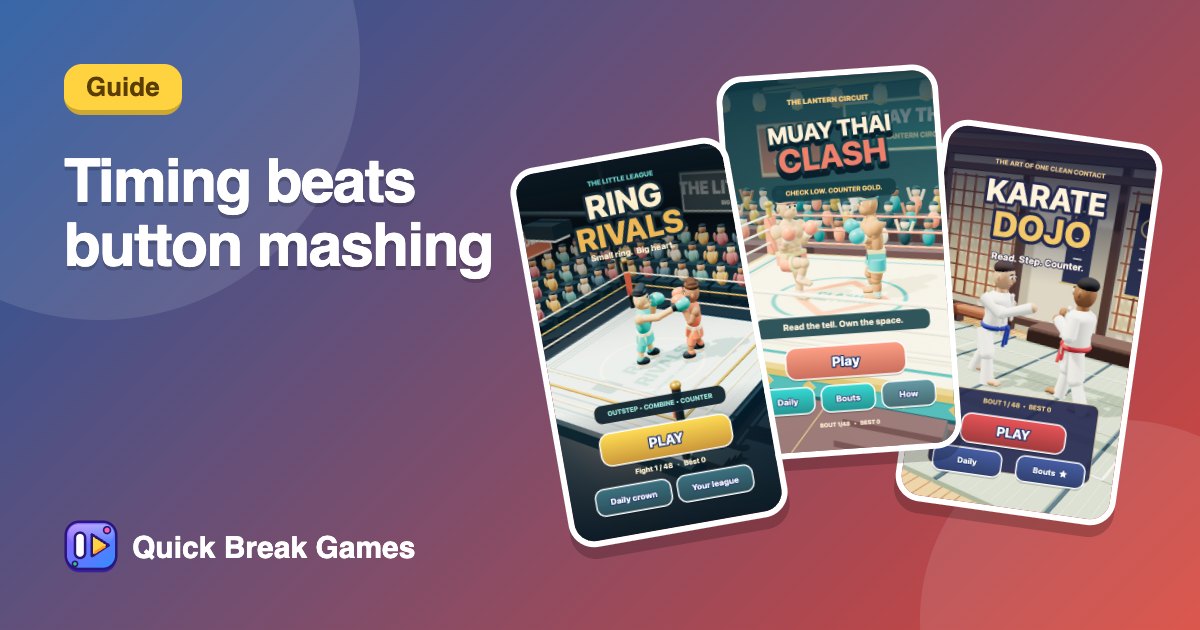
- Matching the defense: Muay Thai Clash separates high guards from low checks and rewards a close-range knee counter.
- Choosing head or body: Ring Rivals combines targets, footwork and energy management in a compact boxing ring.
- Reading an attack line: Fencing Flash uses directional parries followed by a brief riposte window.
Karate Dojo: do not defend the first hint of movement
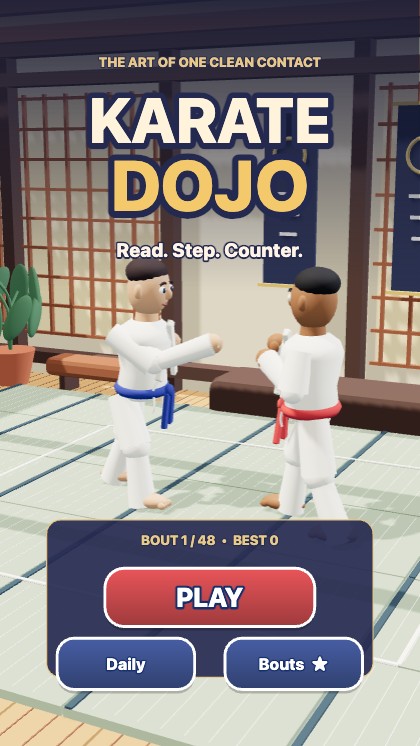
Use STEP IN and STEP OUT to manage the gap. The gold IN REACH ring tells you when an attack can connect. A string of out-of-range attempts spends recovery time without solving the distance problem.
Grey anticipation can be a fake. Wait for the gold commitment, defend, then use OPEN for your response. Defending too early can leave you recovering when the real action arrives. Later bouts require timed counters as well as points, so ordinary contacts alone will not satisfy every goal.
Muay Thai Clash: read height and range separately
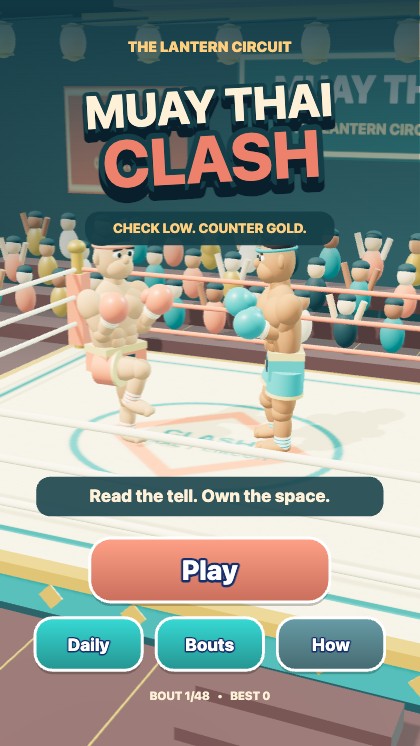
CHECK answers the low-kick cue; GUARD answers the high cue. The opening bouts highlight the matching pad, but later feints can change the warning. Watch the final tell instead of locking in a response at the first flash.
After a successful defense, the gold knee window is only useful if the rival is close enough. Look at the range strip as well as the timer. TEEP can create space, but using it against a distant rival wastes stamina. An unprepared knee is not equivalent to the game's golden counter.
Ring Rivals: leave enough energy to respond
In Ring Rivals, a high guard leaves the body open and a low guard leaves the head open. Change target when the rival changes stance. Jabs are relatively inexpensive; harder combinations and hooks cost more energy.
Back off before the energy bar is empty. A well-timed guard or duck can open a counter opportunity, but you still need reach and recovery time to use it. Some contenders also require timed counters, which prevents a constant stream of ordinary attacks from solving every bout.
Three more ways to think about timing
Fencing Flash distinguishes hollow reading cues from solid commitments. Match HIGH or LOW to the committed line, then respond after CLINK. A lunge includes forward movement, but it still cannot bridge every gap.
Judo Balance is a sequence puzzle about grips, a changing balance arrow, a turn and a controlled release. Pulling again after turning cancels the setup. It is not a game of tapping one direction forever.
Taekwondo Tempo asks you to match a high or body opening while managing kick range. Committed kicks lock movement until recovery finishes. Missing while trying to rush a link can be worse than stepping out and rebuilding it.
A useful first-session routine
- Read the current bout's goal before starting. Some require counters or links, not just points.
- Spend a first attempt identifying the real commitment cue and the reach indicator.
- On the next attempt, aim for a few clean responses rather than maximum button presses.
Solo rivals are simulated sporting opponents. In friend rooms, humans instead play matching seeded solo bouts and compare scores; they do not directly fight each other. The lobby's computer characters are score-comparison opponents too.
For another kind of timing challenge, read the skating tricks and balance guide.