3D skating games: tricks, balance and finding your flow
A skatepark line, a halfpipe and a downhill cone course ask for different skills. These original browser games use 3D scenes, but none is an unrestricted skating simulator. Pick the kind of movement you enjoy, then practise one thing at a time.
Which skating game should you start with?
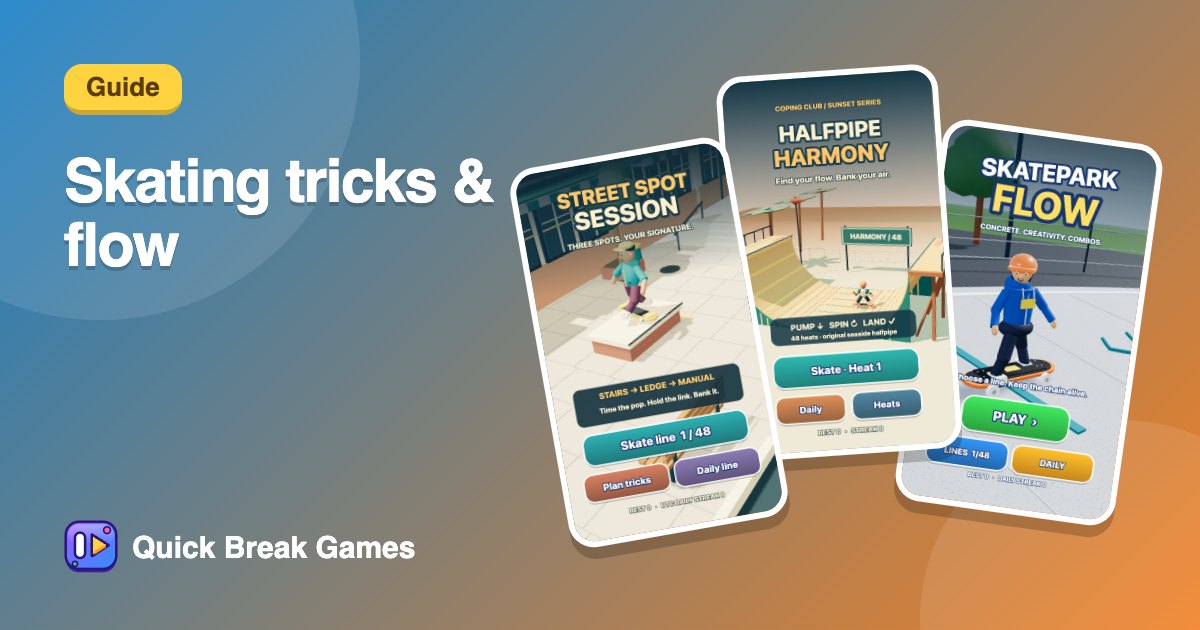
- Tricks and balance: Skatepark Flow handles pushing while you choose a line, charge an ollie and balance a grind or manual.
- Aerial timing: Halfpipe Harmony asks you to pump downhill, coast up the transition and return your wheels to a clean landing angle.
- Planning a street line: Street Spot Session links stairs, a ledge and a manual exit under a shared risk budget.
- Carving rather than jumping: Longboard Slalom rewards early lean changes through alternating cone gates.
Skatepark Flow: line up before you crouch
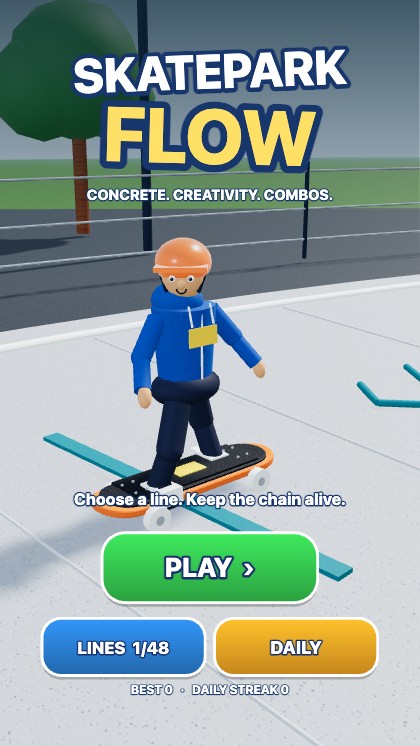
The skater pushes automatically, so use the approach to move sideways into position. Hold to crouch and release at the takeoff stripe. Trying to fix both your line and your release at the last instant makes a simple ollie harder than it needs to be.
Rails and manual pads introduce a separate balance task. Make small corrections against the balance dot rather than chasing its previous position. A slipped trick breaks the flow chain, but already banked points remain: use the next feature to recover instead of abandoning the run.
Orange bowl transfers need a longer charge and an earlier release than ordinary ollies. When that feature unlocks, read its approach arrows instead of reusing the short-jump timing. This is a guided trick-line game, not a free-roam park.
Halfpipe Harmony: height comes before extra spins
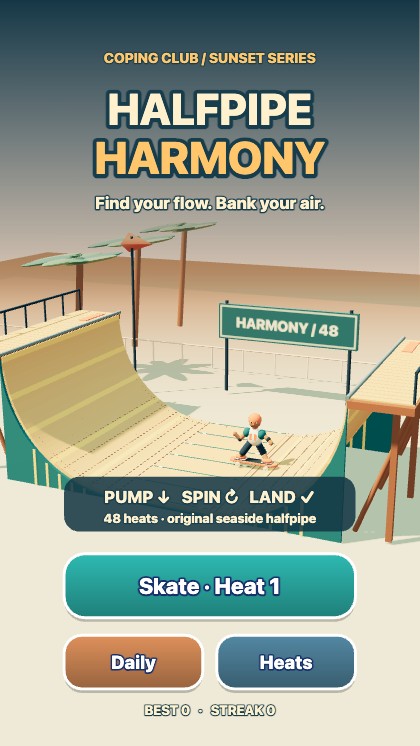
Hold Pump on the downhill transition, then release as you travel uphill. Holding it throughout the entire swing wastes speed. Learn the downhill cue before adding aerial actions.
In the air, a spin or Indy grab only helps if you can finish it. Release the grab before landing and stop rotating near a 180-degree multiple. Start with a simple grab or 180; add another rotation only when your remaining airtime supports it. Varied, clean signatures are more useful than repeating an ambitious miss.
Street Spot Session: make a line you can actually finish
Try the suggested plan in Street Spot Session before spending the full risk budget. Some choices depend on the previous spot: a switch slide needs an earlier 180, and short stairs do not leave enough time for a kickflip.
Press inside the striped timing gate. For a held ledge or manual trick, keep balancing and release at EXIT. Repeating Ollie everywhere is easier, but repeated tricks lose value and do not satisfy a varied-line contract. Change one card at a time so you can tell what made the line harder.
Prefer smooth movement to stunts?
In Longboard Slalom, lean creates sideways acceleration. Begin the next arc after a gate and neutralize before you reach the next opening; waiting until you are beside the cone usually means overcorrecting. Brake before a blue low-speed gate, not on its line.
For a different rhythm, Ice Ribbon combines edge and speed matching with centered spin windows. Disco Roller Beat mixes steering with visually cued spins, poses and reverse pivots. These have their own controls, rather than a shared skateboarding move set.
A short practice challenge with friends
Pick one game, learn its opening challenge solo, then use Host a room and share the code. Each person plays the same seeded solo challenge on their own screen; the room compares scores. You are not skating together in one physical park. Agree on a small goal, such as a cleaner chain, rather than comparing scores from different games.
Want a different kind of movement? Try the 3D racing strategy guide, or browse all games.