Case study: computer players that follow your pace
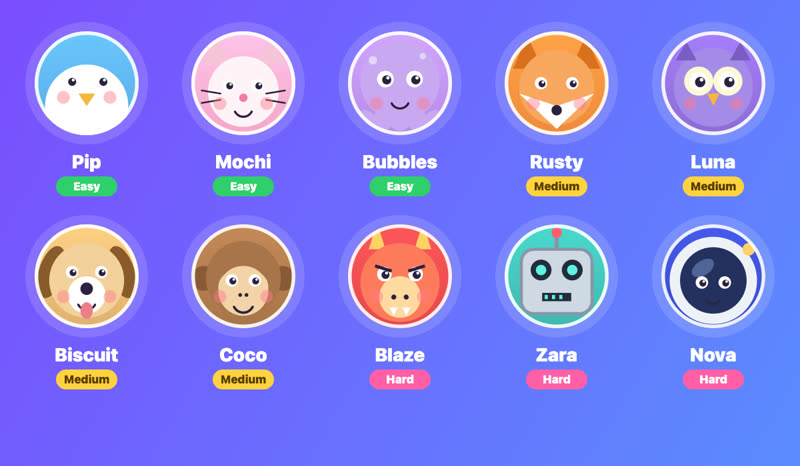
A race is more fun with someone to race. But we have 40 games with 40 different score scales, and no server to run opponents on. This is how we built ten computer characters that work in every game.
The problem
In one game a good score is 20. In another it is 20,000. A computer player that "plays at 500 points" is hopeless in one game and unbeatable in the next. Tuning each of 40 games by hand would take for ever, and it would break whenever a game changed.
The idea: follow the human
Instead of a fixed score, a computer player looks at the best human score a moment ago and multiplies it by its own skill. An Easy character plays at roughly half to two thirds of your pace. A Medium one plays at about three quarters to just under your pace. A Hard one plays at or a little above it. Because it follows you, the same rule works in a runner, a quiz and a puzzle.
Two details make it feel natural. The computer looks about two and a half seconds into the past, so it reacts to you instead of copying you instantly. And it never goes backwards: a score only rises. If nobody is scoring, a computer player stays at zero. It cannot win a race on its own.
Giving each one a personality
Ten characters, with a drawn face each, are spread over three levels. They also have a style that shapes the round:
- Steady (Pip, Rusty, Zara): the same pace all the way.
- Slow starter (Mochi, Luna): wakes up as the round goes on.
- Fast starter (Coco, Blaze): sprints out of the gate and eases off.
- Streaky (Bubbles, Biscuit): hot and cold runs.
- Clutch (Nova): saves the best for the last fifth.
Each round a character picks a skill inside its range, so Pip is not identical twice.
Where it runs
The computer players run inside the host's browser. The host's page writes their scores to the room about once a second, like any other player. No server, no cost per game, and no waiting. If the host closes the page, the computer players pause.
How it did in testing
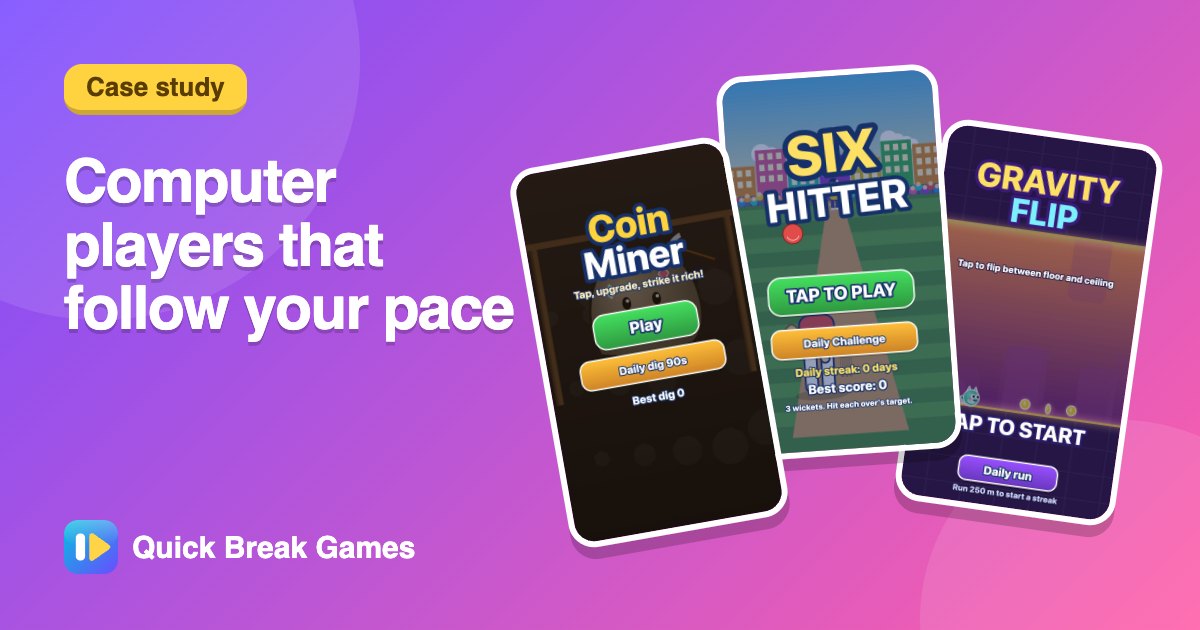
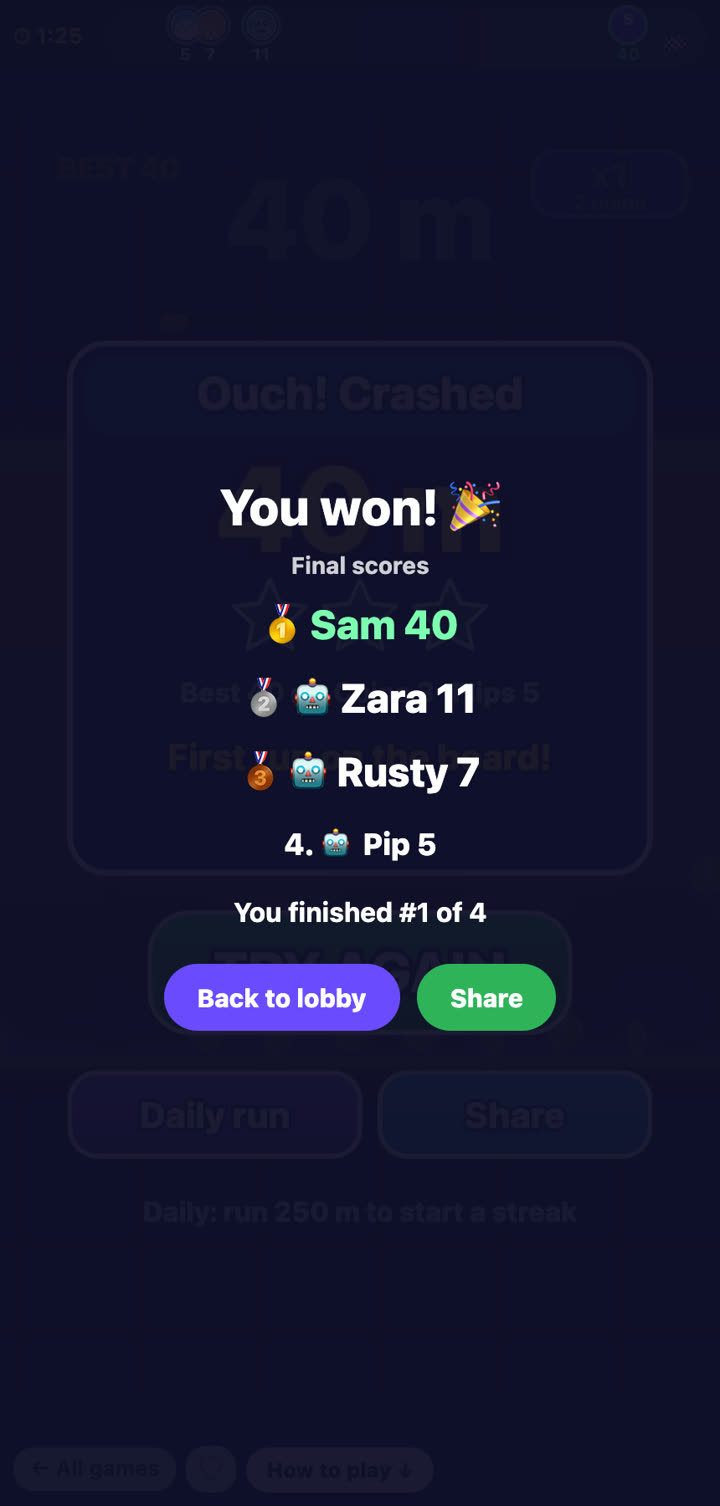
In one test of Gravity Flip, a Hard character (Zara) finished with 51, the human with 48, and an Easy character (Pip) with 28. The order matched the levels. We checked the same ordering across many simulated rounds, and the rule held: Easy below Medium below Hard.
What we learned
- A relative rule beats an absolute one. Following the player scales to any game.
- Players need to see them. Our first version was only a score in a strip, and people could not tell where the computer was. A race track with faces fixed that.
- Be honest about limits. A computer player is a moving score, not a visible player on screen. Showing a bot actually playing is the next step.
Try it: press Play vs computer on the home page, or read the guide to playing against the computer.