Kickbox Counter
An original, non-gory 3D sporting competition in a modeled amber-and-teal industrial training club. Punches and kicks have different, non-overlapping reach bands. Step in for high/body punches and out for high/body kicks. A timely opposite-level punch-to-kick or kick-to-punch chain adds sustained guard pressure; damaged guards recover if you let pressure lapse. A depleted guard creates a real 1.75-second clean-hit window. A matching high/body shield, set close to impact, opens a 1.05-second counter window. Stamina, uncancellable attack recovery and an opponent's guard rhythm make reckless commitment risky. The computer rival uses the same action, range, energy, defense, guard-break and recovery rules. Across 48 seeded, target-based bouts, faster guard rhythms, retreating long-range rivals, reactive bait shields and close pressure returns introduce tactical changes. Most tested bouts last 20–60 seconds, with a 65-second limit. Save unlocks, best scores and stars; replay any unlocked bout. The UTC Daily uses a shared date seed and earns a streak only on a win. Friend rooms compare identical seeded solo bouts, not synchronized human fighters.
How to play
- Watch HIGH ↑ and BODY ↓ guard meters. Step IN, choose a punch, then step OUT and kick the opposite level before the chain expires.
- Keep pressure on weak guards, then strike during GUARD BREAK. Match an incoming HIGH or BODY return with the corresponding GUARD pad shortly before impact; answer during the gold COUNTER window.
- Reach your bout's ring-points target before the rival and the 65-second limit. Tap the pause button or Escape; Enter resumes and R retries solo. Keyboard: J/K punch high/body, U/I kick high/body, A/S guard high/body, Left/Right step in/out.
Tips
- A kick from punch distance or a punch from kick distance misses. Read the named range strip; footwork costs energy but preserves access to combination pressure.
- Mix both attack type and level within 2.6 seconds of a landed strike. Guard damage stops recovering while your combinations keep landing; a guarded weak side can change with the rival's rhythm.
- Do not throw a long kick into a committed return. You cannot defend during attack recovery. Clean defended counters earn 190 ring points, while ordinary open-window hits earn 90.
Questions
Are friends fighting each other in one ring?
No. Each participant faces the identical seeded solo computer-rival bout. Kit compares whole-number skill scores and provides the final podium. The shared Pip character competes on the Kit scoreboard; Pip is not the fighter inside a ring. Each room round is one finite run, without automatic retry.
What saves, and how does the Daily work?
Kit stores unlocked bouts, best score and best stars per bout on the device. Animation frames are not saved. Everyone receives the same UTC date-seeded Daily. Only a won challenge advances its streak, once per challenge date. Consecutive challenge dates extend the streak; a missed day resets it. Finishing across UTC midnight credits the original challenge date, and retry loads the new day's seed.
Is this a realistic martial-arts simulator?
No. It is stylized sporting play about range, pressure and timing, with no gore or real-world instruction. Contact poses and reach bands are arcade abstractions.
What if the graphics stop?
The game pauses on hidden tabs and after WebGL context loss. Graphics restoration keeps the bout paused until you resume. Missing WebGL shows an actionable reload message. Your progression survives reload, and solo pause offers retry or a return to the club.
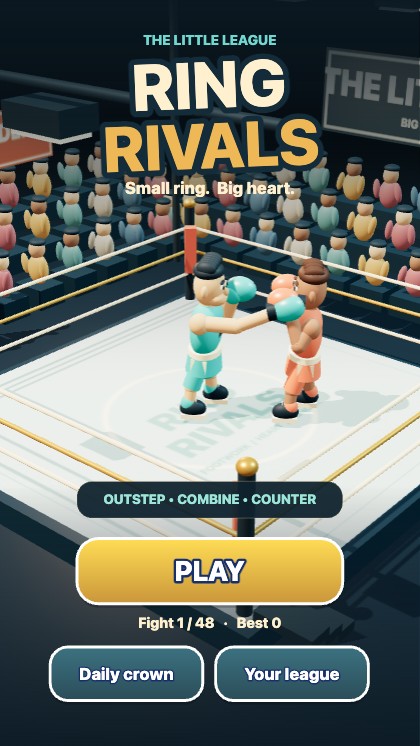 Ring Rivals
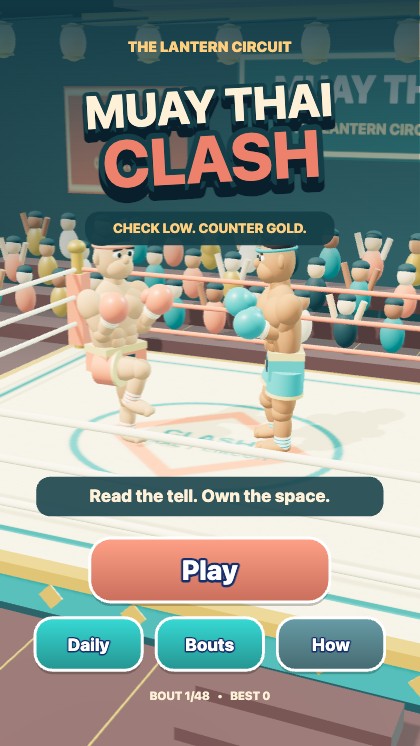 Muay Thai Clash
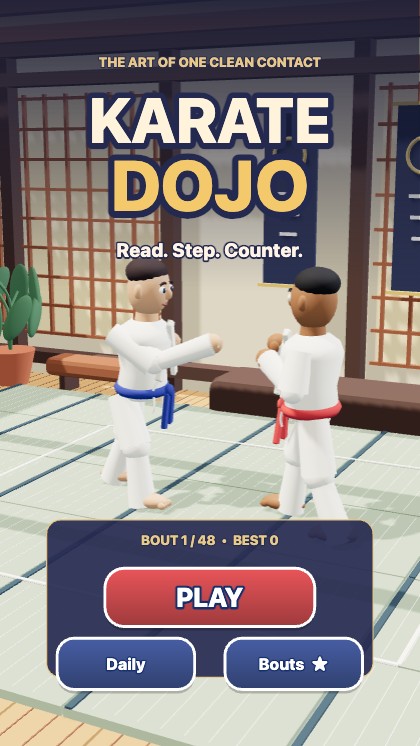 Karate Dojo